
 Français (France)
AD2S Podcast - General Crossonneau: “Operations and Military MRO: Two Sides of the Same Coin”
May 18th, 2026 - Air Brigade General Marc-Olivier Crossonneau was the first speaker during the round table organized by AD2S on January 13th, 2026. As the French Air and Space Force’s “Military MRO General” within the Air Staff, he focused on defining high intensity warfare and what it concretely entails in terms of force generation and technical availability.
Force generation adapted to high intensity warfare: mass, activity peaks and dispersion
In this presentation (transcribed in the podcast available on the AD2S LinkedIn page), General Crossonneau first proposed an operational definition of high intensity warfare, characterized by extremely high operational tempo conducted under severe time and operational constraints, and under permanent direct or indirect threat. A logic which “necessarily drives force and mass generation. We must fly everything we have on the ramps. Even if not all the desired capabilities are always available, because our equipment capacities are by nature finite, the issue here is not perfect optimization, but maximum exploitation of existing assets.”
High intensity warfare also translates into activity peaks added to standing missions (nuclear deterrence, air policing posture), as well as into force dispersion designed to enhance survivability, resilience and unpredictability vis-à-vis the adversary. Such dispersion may be imposed by the nature of the conflict itself and by distances, as currently observed in Ukraine, where mobility and frequent changes of operating bases have become key survival factors.
Generating readiness through the quantification of operational contracts within a multi-domain framework
From a technical and logistical standpoint, the priority becomes generating readiness. This concerns both operational support and industrial sustainment. Such a logic requires a logistical support structure sized to absorb extremely high operational tempos, relying on two pillars: stockpiles and a supply chain capable of rapidly regenerating engaged fleets. This in turn implies the use of simulation tools shared with industry in order to anticipate bottlenecks and assess the actual performance of support chains.
A central issue lies in anticipating requirements. High intensity warfare must be quantified if it is not to remain an abstract concept. This involves translating operational contracts into measurable requirements, integrating operational volumes, tempos, durations and distances, as well as the development of scenarios common to all domains, elaborated jointly with the French Joint Staff and shared with all stakeholders, including industry. The various national defence readiness stages also contribute to this logic by defining what is expected at each level of engagement.
Within the same anticipation-driven framework, dispersion also requires assessing the hosting capacity of civilian, military or allied platforms, while pursuing greater frugality in support assets in order to limit logistical dependencies.
ORM, or the return to “technical common sense”
The need to accelerate aircraft return-to-service naturally implies, within a controlled framework, deviations from traditional regulatory structures whenever operational imperatives require it: what the French Air and Space Force refers to as GRO (“gestion du risque opérationnel”) – ORM in English for a wartime-oriented form of “Operational Risk Management”).
General Crossonneau therefore emphasized a key lever: changing mindsets regarding acceptable risk. Risk-taking is inherent to combat aviation. The challenge lies in constantly reassessing the balance between safety, operational performance and availability according to the criticality of the mission at hand. This requires distinguishing, at every level - including within airworthiness regulations - what is absolutely critical and essential, and what is merely desirable, in order to enable informed decisions at the right moment. The objective is not to sacrifice safety at all costs, but rather to provide military authorities with the elements needed to decide whether an aircraft can accomplish its mission at a given moment even if it does not fully comply with standard technical criteria.
To achieve this, it is essential to regain greater technical autonomy and technical common sense, together with direct access to industrial expertise. Since military MRO and operational employment ultimately constitute “two sides of the same coin in operational terms,” this logic is now translating concretely into ongoing internal reorganizations within the French Air and Space Force: pilot-maintainer teaming at every level, integrated structures from Air Staff headquarters down to squadron level, and increased recognition of maintainers’ expertise.
In a high intensity context, the ultimate objective is clear: being capable of rapidly returning an aircraft to flight operations, with a risk that has been identified, accepted and decided upon by military authorities, in support of air superiority.
By Murielle Delaporte
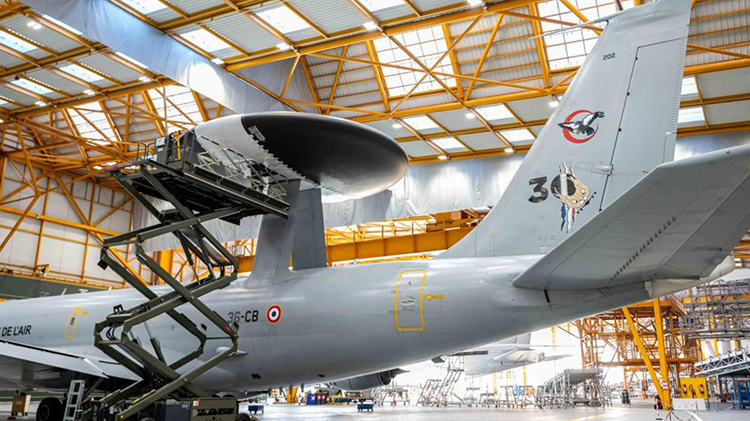
Photo: Maintenance of an E-3F AWACS rotodome by the teams of the Aeronautical Technical Support Squadron (ESTA) of the 36th Airborne Command and Control Wing (EC2A) at French Air Base 702 in Avord, during exercise “Taranis” (“Tactical Airlift Rehearsal Under Advanced Non-permissive and Intensive Scenarios”), designed to prepare the units of the Air Assault and Projection Brigade (BAAP) for operations in non-permissive and high intensity environments © French Air and Space Force, November 2025, www.defense.gouv.fr/air/exercice-taranis-transport-aerien-militaire-au-coeur-haute-intensite/taranis-avord-mecaniciens-mobilises
Podcast available on the AD2S LinkedIn Page.