
 Français (France)
Mini Cranes: Enabling Equipment for Forward-Deployed Military Aviation MRO
April 26th, 2026 - “Give me a firm place to stand, and with a lever I will move the earth,” Archimedes once said. In military operations, that fulcrum may take the form of seemingly secondary support equipment. Yet its failure can be enough to compromise the entire system.
In overseas operations, the breakdown of a simple material-handling asset has, on occasion, been enough to disrupt the course of a mission or compromise the security of a forward operating base. Within hours, a tactical vulnerability can emerge from the failure of an otherwise inconspicuous link in the support and supply chain. Improving the reliability of such equipment is therefore a key requirement in preparing for conflict, especially in high-intensity scenarios.
Though often overlooked, the selection of support equipment designed to sustain aircraft operational readiness in the field is critical. Lifting equipment is part of this equation and is now benefiting from ongoing technological advances that Air Forces can leverage. This article examines the emergence of increasingly compact and connected cranes, and the operational advantages they may offer in operational environments.
Originally developed in the civilian sector to meet highly specific industrial requirements, mini cranes are gradually emerging as a tool of choice for military MRO and advanced support operations within European air forces.
Given their characteristics, combining compactness, performance, and air transportability, they are well suited for integration into support modules aligned with the Agile Combat Employment (ACE) concept of dispersed operations, which requires a reduced logistical footprint, high mobility, and the use of mature commercial off-the-shelf solutions (COTS)[1].
High-intensity operations, in turn, imply a form of what could be described as “logistical disaggregation,” involving the fragmentation of support nodes, transport assets, and supply routes, and challenging many traditional assumptions about sustainment. Recent concepts developed within allied forces, such as those of the U.S. Navy, “emphasize greater geographical distribution within and across theaters of operations, reduced reliance on fixed infrastructure, and enhanced force resilience in the face of attack, each of these factors carrying its own logistical costs”[2].
From Industrial Origins to Military Aviation MRO
The Industrial Origins of Mini Cranes
While motorized mobile lifting equipment began to develop in the early 20th century, particularly after 1945 with the introduction of hydraulic cranes equipped with telescopic booms, new-generation mini cranes started to emerge in Japan as early as the 1960s. It was, however, from the 1980s onward that tracked or spider-type lifting equipment demonstrated their ability to operate in confined spaces, including inside buildings, while handling significant loads[3].
Their adoption in Europe accelerated in the early 2000s, driven by several converging factors: the widespread use of hydraulic telescopic booms[4], the miniaturization and improved reliability of hydraulic systems, and the gradual integration of control electronics and load moment indicators (LMI)[5].
At the same time, increasingly stringent workplace safety requirements and environmental constraints encouraged the development of solutions that were not only highly mobile and suitable for use in confined industrial environments (factories, refineries, or hangars)[6], but also electric or hybrid, enabling operations with zero local emissions (a decisive advantage in sensitive or enclosed settings).
It was in civil aviation and the MRO sector that these machines first found a natural niche. Mini crawler cranes, or “spider” cranes, are used to handle engines, fuselage sections, landing gear, and other bulky components in hangars where space and headroom are limited.
Spider cranes are highly compact lifting systems, typically tracked, and equipped with four (sometimes more) articulated stabilizers that extend around the machine like a spider’s legs, hence the name. In transport mode, all components are folded, allowing the narrow, low-profile machine to pass through standard doors, corridors, or other highly constrained access points. In operating mode, the stabilizers deploy widely to ensure stability, even on uneven surfaces, ramps, or elevated structures such as rooftops.
Their ability to access confined spaces, deploy rapidly, and operate in close proximity to aircraft has made mini cranes a preferred solution for reducing maintenance downtime and limiting the risks associated with manual handling.
Early European military applications: Denmark and Belgium as pioneers
European armed forces were quick to recognize the potential of these capabilities, with Denmark providing one of the earliest well-documented examples. As early as the mid-2010s, UNIC Cranes Europe (a subsidiary of the UK-based GGR Group Ltd) reported training Danish military personnel in the use of mini cranes for helicopter maintenance operations, including blade removal, gearbox removal and reinstallation, and the handling of blade storage containers[7].
In 2020, the Danish Ministry of Defence took a further step by procuring twelve UNIC URW-1006+ tracked mini cranes. These systems are primarily intended for engine lifting operations on Leopard 2 tanks, as well as other heavy maintenance tasks. Although this example is land-based, it illustrates how a NATO member has integrated mini cranes into its deployable maintenance capabilities, extending beyond the confines of fixed workshops[8].
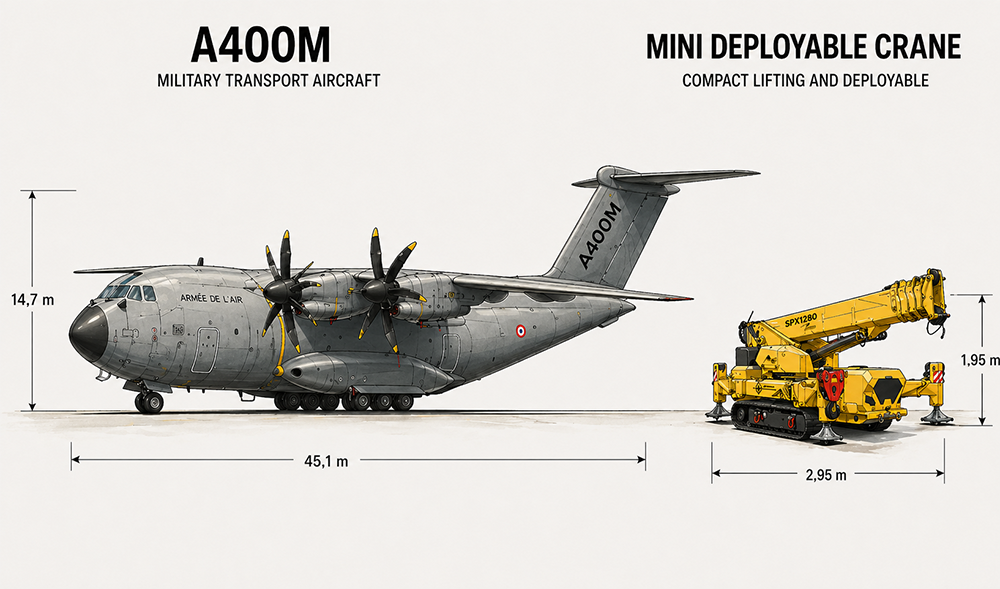
In the air domain, the Belgian case is particularly noteworthy, especially in light of ACE-related requirements and the growing emphasis on deployable, modular support capabilities. In 2021, the Italian manufacturer Jekko, in cooperation with the Belgian Armed Forces and its distributor Rentalift, developed an SPX1280 mini crane optimized for supporting the Airbus A400M fleet. With a maximum lifting capacity of 8 tons and a “pick and carry” capacity of 2 tons, this system is designed to be airlifted by an A400M, and potentially delivered by airdrop[9].
In practical terms, if an A400M becomes inoperative in a remote location, another A400M can airlift a mini crane along with a maintenance team to carry out major repairs on site. The same type of equipment is also used to support aviation MRO activities at Belgian bases. This provides a concrete example of how mini cranes can be integrated into advanced support concepts, foreshadowing what an ACE-type support module could look like.
A Tool Tailored For ACE And Distributed Operations In Europe
A logistical asset adapted to high-intensity constraints
NATO and its member states have, for several years, been working to adapt the Agile Combat Employment (ACE) concept to European operational realities, particularly on the Northern and Central flanks, where dense infrastructure and the proximity of a peer adversary require increased dispersion.
In this context, the success of ACE does not depend solely on deployed aircraft, but also on the ability to project and preposition light, modular support assets that can be shared and employed across allied forces[10].
Against this backdrop, mini cranes offer several key operational advantages:
- Strategic and tactical mobility: The Belgian example demonstrates that a mini crane can be integrated into the deployment chain of a tactical transport aircraft, including operations into austere environments. Transportable by road on a flatbed truck, by rail, or by cargo aircraft, it expands the range of support options in remote or infrastructure-constrained locations[11].
- Reduced logistical footprint: Compared to bulkier lifting equipment, mini crawler or “spider” cranes offer substantial lifting capabilities in temporary hangars, lightweight support structures, or on rudimentary parking areas and runways, without requiring heavy infrastructure such as gantry or overhead cranes. They are already used in civil aviation for tasks such as engine removal and installation, as well as the handling of airframe components.
- Enhanced safety and ergonomics: These systems eliminate the need for hazardous manual handling or improvised solutions (makeshift hoists, repurposed construction equipment). Versions certified for high-risk industrial environments already exist (e.g. hazardous storage facilities or sensitive depots), making them well suited for use in ammunition storage areas or refueling zones subject to stringent safety requirements.
- Interoperability and pooling & sharing: The modernization of military lifting fleets across Europe (including crane-equipped logistics vehicles in service with the Bundeswehr and Liebherr/Grove systems for France and the Czech Republic) illustrates a broader shift toward more standardized and interoperable capabilities within NATO. Over time, NATO-compatible mini cranes could be shared across multinational logistics hubs, in the same way as other support assets[12].
Looking ahead: toward more capable and connected mini cranes
Several trends suggest that the role of mini cranes in forward deployed military aviation MRO could expand in the coming years.
On the one hand, the growing need for preconfigured ACE support modules - combining resupply, munitions, energy, and maintenance - favors compact, standardizable, and off-the-shelf equipment. Within this COTS framework, mini cranes, already widely used in civil engineering and aviation, emerge as natural candidates for equipping forward operating bases or shared support facilities.
On the other hand, European and NATO initiatives in capability development and cooperation provide a framework conducive to greater standardization of support equipment, even if the development of common specifications for this category of systems remains limited at this stage. The emergence of a “Military Schengen” for European military mobility could further accelerate this standardization trend.
From a technological perspective, mini cranes already incorporate proven industrial components, including sensors, safety automation systems, load moment indicators (LMIs), and, increasingly, telemetry capabilities. As such, they can be considered “assisted” systems, capable of enhancing the safety of lifting operations while generating data to support usage monitoring and maintenance.
While the most advanced features, such as automated anti-collision systems or the optimization of operations through data analysis, remain primarily deployed on heavy-duty cranes, some of these capabilities are beginning to appear, albeit to a limited extent, on more compact systems.
In a context of dispersed operations and reduced manpower, these developments, even when incremental, can contribute to improved operational safety, facilitate use by less specialized personnel, and enhance overall equipment availability.
At this stage, rather than a technological breakthrough, this evolution remains incremental, with mini cranes following the broader trajectory of industrial equipment toward greater automation, connectivity, and usage monitoring.
Over time, the integration of these systems could help improve the monitoring and availability of deployed mini-crane fleets. Telemetry capabilities, already present on certain models, enable more granular tracking of usage, facilitating maintenance planning and, to a certain extent, more efficient allocation across different sites.
In a context of scarce and dispersed resources, combined with an accelerating operational tempo, the maintenance of support equipment itself becomes a critical factor. In this “MRO of MRO” logic, support assets are no longer just enablers, but systems to be monitored, managed, and optimized in their own right, contributing directly to the overall robustness of the support architecture.
From this perspective, light lifting is not, maybe more than ever, merely a support function, but a key enabler of resilience in contested logistical environments.
By Murielle Delaporte
Notes:
[1] The JAPCC refers to the concept of agile forward logistics: « Agile Forward Logistics: The need to responsively deploy, forward-deploy, and sustain forces at multiple location while executing operations across domains can place significant strain on logistical capabilities but is necessary for MDO. Training and exercising agile forward logistics elements, to include multi-capable airmen and pre-positioned support equipment, minimizes the requirements for deploying and sustaining air elements, enabling agility for forward forces. » (Quote from : Lieutenant Colonel Isaiah Oppelaar, USAF, Agile Combat Employment: The Next Big Thing for NATO Air Power, Joint Air Power Competence center, 2023 / https://www.japcc.org/articles/agile-combat-employment/)
[2] “In general, Navy and other Service concepts emphasize geographic distribution within and across theaters, decreased dependence upon fixed sites, and greater force resilience in the face of attack, each of which carries logistics costs. ” (Quote from: Timothy A. Walton, Ryan Boone, Harrison Schramm, Sustaining The Fight: Resilient Maritime Logistics For A New Era, Center For Strategic and Budgetary Assessments (CSBA), Washington, D.C., 2019 / https://csbaonline.org/uploads/documents/Resilient_Maritime_Logistics.pdf)
[4] Hydraulic telescopic boom technology - based on multi-stage cylinders – has enabled cranes to achieve a reduced transport footprint while increasing their operating radius. It is therefore a key enabler in the development of modern mobile and mini cranes. (https://www.eepos.de/fr/glossaire-lexique/flèche-de-grue/)
[5] This refers to the transition from purely hydromechanical cranes to systems equipped with sensors and onboard computing that continuously monitor operating parameters such as load, boom angle, reach, and movement limits. In practical terms, this involves sensors on cylinders, rotation axes, and cables, combined with a central processing unit (CPU and embedded software) that calculates operating conditions in real time. This information is displayed to the operator in the cab, including load, height, radius, and safety margins. These electronic systems also enable the integration of operator assistance functions, such as automatic speed limitation, movement restrictions in hazardous zones, data logging, and fault diagnostics. (https://www.fcba.fr/wp-content/uploads/2020/11/Note_ControleIntuitif_vf_Publique_MAJ062019.pdf)
[6] https://www.europe-tp.com/actu-tp/a46297/grues-mobiles-engins-incontournables-construction-html
[7] https://www.cranebriefing.com/news/unic-mini-cranes-for-military/1099657.article?zephr_sso_ott=0FKu ; https://www.ggrgroup.com/wp-content/uploads/2014/07/UNIC-mini-crane-training-for-the-military.pdf
[8] https://www.uniccranes.com/news/12-unic-urw-1006-mini-cranes-delivered-to-danish-defence/ ; https://www.khl.com/news/a-dozen-unic-cranes-delivered-to-danish-military/1144550.article
[9] https://www.craneandhoistcanada.com/mini-cranes-away-manufacturing-a-military-solution/
[10] https://othjournal.com/2024/10/06/european-air-operations-agile-combat-employment/; https://www.japcc.org/articles/agile-combat-employment/
[11] https://www.airuniversity.af.edu/Wild-Blue-Yonder/Articles/Article-Display/Article/2949295/the-case-for-ace-infrastructure-in-eucom/
[12] https://www.liebherr.com/fr-fr/grues-mobiles-et-sur-chenilles/grues-mobiles/grues-militaires-4115329 ; https://www.nato.int/fr/what-we-do/deterrence-and-defence/multinational-capability-cooperation ; https://defence-blog.com/german-army-receives-first-armoured-mobile-and-rescue-cranes/ ; https://www.czdefence.com/article/manitowoc-grove-mobile-cranes-strengthen-the-logistical-interoperability-of-the-czech-armed-forces-within-nato
Illustration: AI-generated illustration (non-contractual), based on publicly available data and Belgian operational feedback on the integration of SPX1280-type mini cranes in support of the A400M fleet. These systems, with a maximum lifting capacity of around 8 tons (2 tons in “pick-and-carry” mode), are designed to be airlifted by tactical transport aircraft and, in some configurations, delivered by airdrop.