
 Français (France)
AD2S Podcasts - Military MRO: Getting Ready To Hold The Line, Together
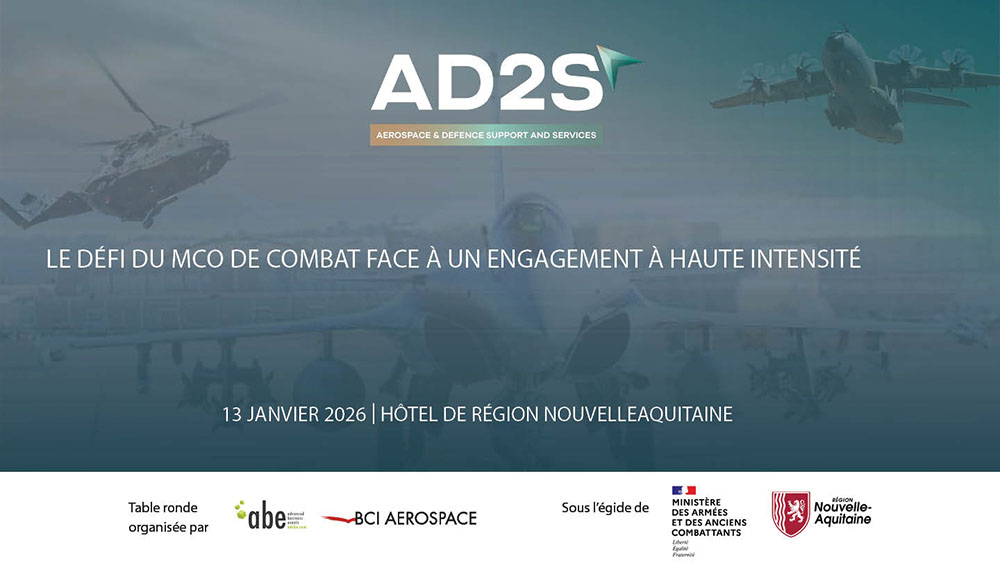
January 26th, 2026 - On January 13, 2026, AD2S hosted a roundtable at the « Hôtel de Région Nouvelle-Aquitaine ».
Moderated by General (ret.) Jean-Marc Laurent, Executive Director of the Defense and Aerospace Chair, the conference focused on "The Challenge of Combat MRO Under High-Intensity Engagement" and brought together the following speakers:
- General Stéphane Groën, Territorial Commander of the French Air and Space Force, General Officer for the South-West Defense and Security Zone
- General Marc-Olivier Crossoneau, in charge of MRO, French Air and Space Force
- Pierre Daubin, Commercial Director, General Directorate of Military Support (DGSM), Dassault Aviation
- Gilles Gaillot, Strategy & Marketing Director, Thales DMS France
- Julien Köhli, Head of French Airbus Services Centers, Airbus Defence & Space
- General Eric Le Bras, Deputy Technical Director, Directorate of Aeronautical Maintenance (DMAé)
We are publishing a series of podcasts covering the highlights of this roundtable, beginning with the introduction by General (ret.) Jean-Marc Laurent, summarized below.
Introduction by General (ret.) Jean-Marc Laurent
Military MRO: A Core Military Capability
The 2026 AD2S event takes place against a deeply troubled backdrop, which makes its relevance and urgency more pressing than ever. Four major factors underpin this necessity.
The first is the geopolitical and security context. The risk of a major high-intensity conflict is no longer theoretical: it is now feared within a three-to-four-year horizon. That compressed timeline demands a clean break with established habits. Since force capabilities cannot be significantly increased in so short a period, only deeper cooperation between the state, the armed forces, and industry - combined with bold innovation - will make it possible to improve capability and "hold the line." This is particularly true in the air domain, where recent conflicts have demonstrated, unambiguously, that air power has emerged as one of - if not the - central military capability. In that regard, they have also shown that aeronautical maintenance and readiness or military MRO can no longer be treated as a mere support service: it is a full-fledged military capability in its own right.
The second factor is the weakening of traditional alliances, both military and industrial. These alliances remain essential, but their solidity and durability can no longer be taken for granted, forcing a rethink of cooperation models that must be grounded in burden-sharing that does not erode strategic autonomy or military power. Transatlantic cooperation, in particular, must not become a source of operational vulnerability. The EU, for its part, carries genuine ambition - but that ambition is primarily medium- to long-term in nature and does not address the current urgency. It also has limited bearing on high-end weapons systems. Without calling these frameworks into question, the imperative is to combine national effort with targeted bilateral or multilateral cooperation, under identified leadership, for major systems and their MRO. AD2S aims to contribute to this, notably through a proposed "Forum of European military MRO Directors."
The third factor is political and economic in nature France has entered a logic of "preparing for war" (2025 National Strategic Review), without yet crossing the threshold of a "war economy." While notable efforts exist in the area of mass-produced munitions, the air domain faces industrial constraints that impede scaling up. The need to "do things differently", which the 2025 NSR identifies as a strategic imperative, is therefore essential: adapting decision-making and contracting processes, innovating in production and MRO methods, revisiting operational risk management, and more. AD2S intends, at its level, to explore these challenges.
The fourth factor is operational. French forces are battle-hardened, well-trained, operationally engaged, and prepared for high-intensity scenarios. But they also carry the legacy of a decade — the 2010s — marked by sweeping reductions in capability, equipment, and personnel. Headcounts are not meaningfully growing, and overall combat power, outside of nuclear deterrence, remains insufficient for the demands of a major conflict. Under constrained budgets, this demands a transformation of the relationship between the state, the armed forces, and the defense industrial and technological base.
AD2S positions itself as a space for reflection on this transformation for the good of a collective resilience up to the level of the challenges ahead.
The full remarks by General (ret.) Laurent are available in French on the AD2S LinkedIn page.
By Murielle Delaporte