
 Français (France)
AD2S Podcast - High Intensity: Preparing for Combat MRO on the Industry Side
February 23rd, 2026 - Airbus Defence and Space Faces High Intensity: Anticipating the Loss of "Tempo Control"
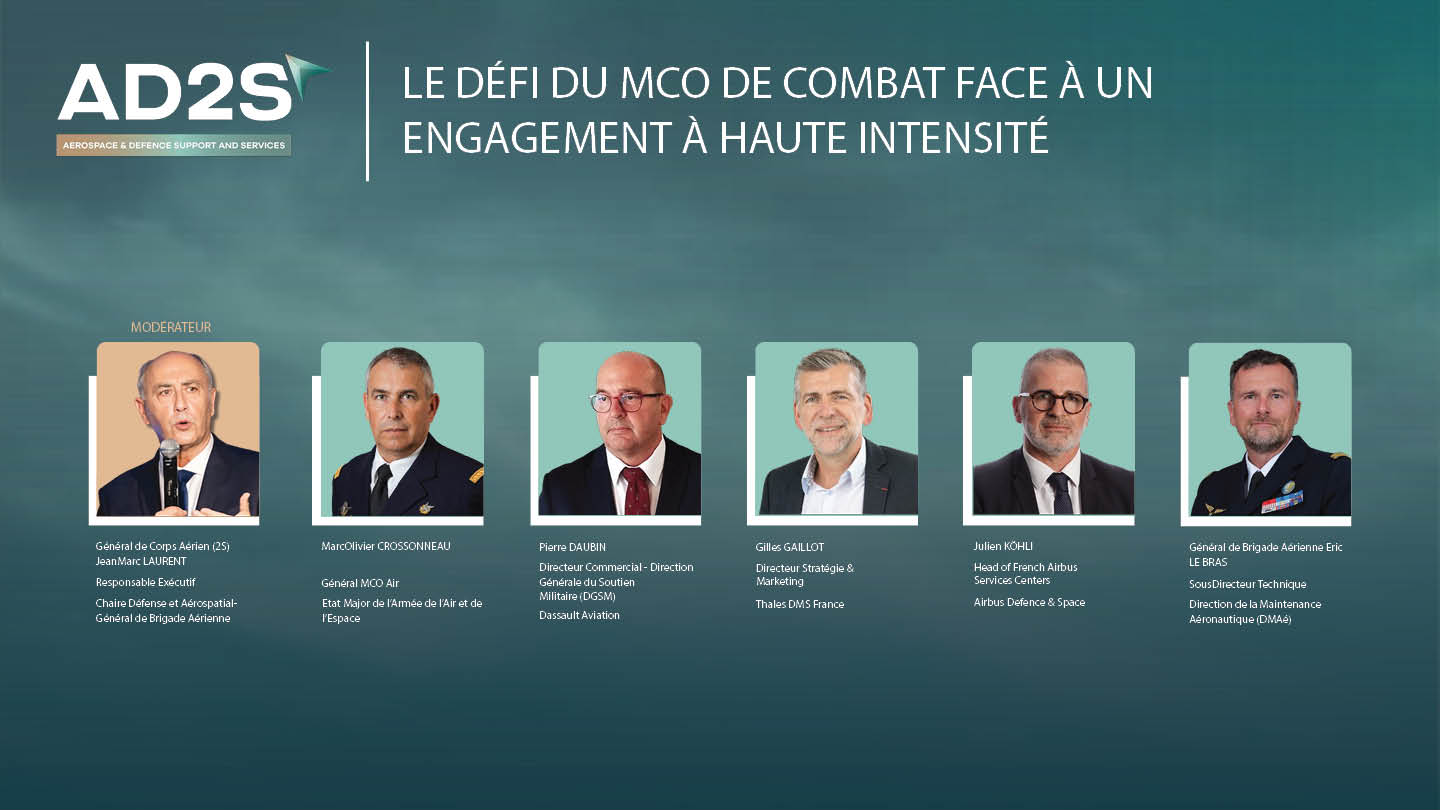
During the AD2S roundtable on January 13th, 2026 - themed "The Challenge of Combat MRO Under High-Intensity Engagement" -, Julien Köhli, Head of French Airbus Services Centers at Airbus Defence & Space, offered an industrial perspective on what high-intensity conflict actually means for a major player in military aeronautical support.
His contribution reflects the standpoint of Airbus as a "player in maintaining operational readiness and supporting the armed forces," rather than as an aircraft manufacturer.
Industry and High Intensity: A Real Wake-Up Call After French Exercise Orionis 2023
Köhli opened by highlighting the paradigm shift that has taken place at Airbus in recent years. Driven directly by France, and more specifically in the aftermath of the lessons learned from the Orionis 2023 exercise, the company has come to understand what high intensity truly demands of MRO. This awareness is neither abstract nor theoretical; it stems from in-depth discussions with the armed forces, particularly the French Air and Space Force, on credible scenarios for major engagement.
It is in this context that Airbus launched a dedicated project on combat MRO just over a year ago, named HIC for "High Intensity Conflict." Its ambition: to prepare the company to "do things differently" and “with a different mindset”, breaking with the peacetime framework when that framework no longer meets operational requirements. The project is part of a broader effort, coordinated with other internal and European initiatives, that extends beyond MRO to examine all industrial processes affected by high-intensity conflict.
A key point in Köhli's remarks concerns the diversity of scenarios under study. High intensity does not follow a single template; it encompasses a range of configurations that vary in how they are triggered, how long they last, how intense they become, and where they occur. While European nations share certain convergences in their understanding of high intensity and the responses it demands, significant differences remain in threat perception and priority theaters. Airbus is therefore working across multiple scenarios, one of which closely mirrors the French vision developed since ORIONIS 2023. That proximity to the armed forces gives the manufacturer a structural advantage in shaping its project.
However, while conflict in Europe naturally commands the most attention, the Indo-Pacific is becoming an increasingly critical focus, particularly for partners like Australia, which are watching regional power shifts closely. The challenge for Airbus is therefore not to produce a single universal answer, but to build adaptable capabilities that can be tailored to different partners. "We are trying to capture all these needs in order to come up with a response that will not necessarily be universal, but at least one that will suit the greatest number, and we will adapt it to the different players," Köhli explained.
With a fleet of around 1,500 aircraft designed, produced, and fielded by Airbus Defence and Space, the company must make clear choices. The HIC project covers roughly 60% of that global fleet, focusing on the platforms most likely to be engaged in high-intensity operations: "100% of MRTT tankers, 100% of A400Ms and almost all Eurofighters, with the exception of a few units." Such a mobilization reflects an operational reality in which transport, refueling, and force projection aircraft are central to the conduct of a major conflict, both in terms of rapid force generation and sustained engagement.
Beyond Logistics: Coping With the Loss of Controlled Industrial Tempo
One of the most disruptive features of high-intensity conflict is the inability to anticipate the pace of events in the fog of war. "How much preparation time will we have once hostilities break out? And how long will the supply chain hold?" These are questions without certain answers, which is precisely why the approach must be scenario-based and built to anticipate worst cases while maximizing endurance over time. What is certain is that high intensity produces a sudden surge in requirements across logistics, industrial capacity, human resources, and geographic deployment simultaneously.
Current arrangements, heavily centered on Main Operating Bases, may prove unsuitable in an HI conflict, giving way to smaller, more dispersed structures using non-standard civilian or military platforms, sometimes far removed from traditional logistics patterns, in line with French ACE (Agile Combat Employment) dispersal strategy.
"We will not be able to respond to high intensity (HI). The project as it stands has identified points which mean that, if we remain as we are, we will not be able to respond. (...) An approach based solely on stocks will not be able to cope with HI either. (...) Equipment is an essential variable, but clearly the robustness of the supply chain and the ramp-up that would be necessary - if there were only a logistical response - could not be implemented," Köhli acknowledged, underlining the hard limits of a purely logistical approach when confronted with the volumes, timelines, and disruptions of a major conflict.
This challenge extends well beyond Airbus itself. If the manufacturer is ready, what about its entire supply chain? Getting that chain fully on board - down to relatively low tiers - is critical to sustainment over time.
The Need To Retrain Engineers
Airworthiness standards, export controls, and customs procedures are essential frameworks in peacetime. Under high-intensity conditions, however, these same regulations can become serious obstacles. Without abandoning fundamental safety principles, Airbus is exploring where adaptation is possible. The goal is not to break rules but to manage risk in a conscious, controlled, and documented manner, in close coordination with the armed forces. Structured around 52 sub-projects, the HIC project treats aeronautical risk management as a multi-dimensional challenge and priority.
The development of decision-support tools is central to this effort, empowering field forces with access to reference materials, pre-existing solutions, and procedures adapted to combat damage. The win-win payoff is twofold: it shortens decision loops on the operational side while "freeing up engineering resources at [Airbus], which can then focus on issues that cannot be addressed by either a tool or documentation."
Beyond the tools, Köhli emphasizes the profoundly human and cultural dimension of this transformation. Engineers, technicians, and industrial partners have spent years operating within a highly standardized airworthiness framework that leaves little room for deviation. High intensity demands the ability to shift reflexes when the moment comes. Exercises play an important role in building that culture, but, in his view, they are not enough. The task now is to "scale up" to HI: structure training, prepare personnel, and even consider the status of civilian teams likely to operate near combat zones.
Ensuring continuity of service under degraded conditions is also on the table, and once again, the objective is to bring the entire supply chain along. "If Airbus is ready, that's great. But what about its supply chain? We need to get the entire supply chain on board at a relatively low level, so that it too is ready and can support us and ultimately support [the forces] in high-intensity situations. So it's a pretty huge task of acculturation and discussion to see what solutions the supply chain can bring. (...) Today, we are digitalizing, we have a lot of tools, we communicate a lot. How should we proceed tomorrow if these tools fail, if we can no longer communicate? (...) We will have to come up with solutions on D-day, if all this collapses."
For Köhli, it is now necessary to "activate a new form of governance capable of responding to high intensity" and the definitional, formalization, and training work required to get there must begin immediately.
This podcast offers a rare window into how a major European defense industrialist is preparing for the concrete reality of high-intensity warfare. It also illustrates the driving role France is playing in this dynamic and highlights just how deep the transformations must go if combat MRO is to support and sustain in the long run military operations when the day comes.
By Murielle Delaporte
Listen to the Podcast via AD2S LinkedIn.